> For the complete documentation index, see [llms.txt](https://docs.overthereality.ai/over-sdk-manual/llms.txt). Markdown versions of documentation pages are available by appending `.md` to page URLs; this page is available as [Markdown](https://docs.overthereality.ai/over-sdk-manual/over-visual-scripting-legacy/nodes/flow/other-events/collision.md).

# Collision

### Description

This collection of [OverNode](/over-sdk-manual/over-visual-scripting-legacy/visual-scripting-essentials/overnode.md)s represents all the nodes that interact with the physics Unity Collision system.

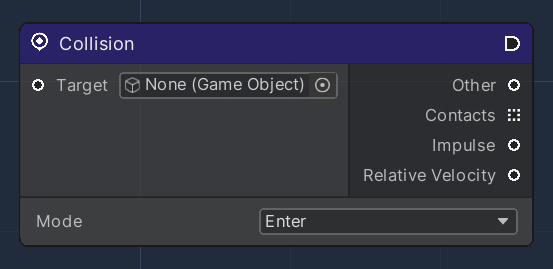
#### Collision Node

The main element of this collection consists of a Collision Node, that fires its execution on detecting a specific Collision event.

Each Collision Node must refer to a specific `Target` GameObject, accordingly equipped with a Unity [Collider](https://docs.unity3d.com/ScriptReference/Collider.html) Component. Once a collision is detected, the following nodes will be executed.

A `Mode` parameter can be selected in order to further customize the execution of the node, specifically:

<table><thead><tr><th width="204">Name</th><th>Description</th></tr></thead><tbody><tr><td>Enter</td><td>Sets the node to be executed when a physical object enters the Target Collider space</td></tr><tr><td>Stay</td><td>Sets the node to be executed when a physical object stays inside the Target Collider space</td></tr><tr><td>Exit</td><td>Sets the node to be executed when a physical object exits the Target Collider space</td></tr></tbody></table>

The Node also exposes some parameters, also describing the Collision itself:

<table><thead><tr><th width="205.7659040188865">Name</th><th width="194.3279424240331">Type</th><th width="340.1572968009442">Description</th></tr></thead><tbody><tr><td>Other</td><td><a href="https://docs.unity3d.com/ScriptReference/Collider.html">Collider</a></td><td>A reference of the input Unity Collider Component of the object colliding with the Target</td></tr><tr><td>Contacts</td><td>ContactPoint [ ]</td><td>List of contact points where the collision occurs</td></tr><tr><td>Impulse</td><td>Vector3</td><td>The total impulse applied to this contact pair to resolve the collision</td></tr><tr><td>Relative Velocity</td><td>Vector3</td><td>The relative linear velocity of the two colliding objects (Read Only)</td></tr></tbody></table>

<figure><img src="/files/8miScSgStNfFkHfFatMF" alt=""><figcaption></figcaption></figure>

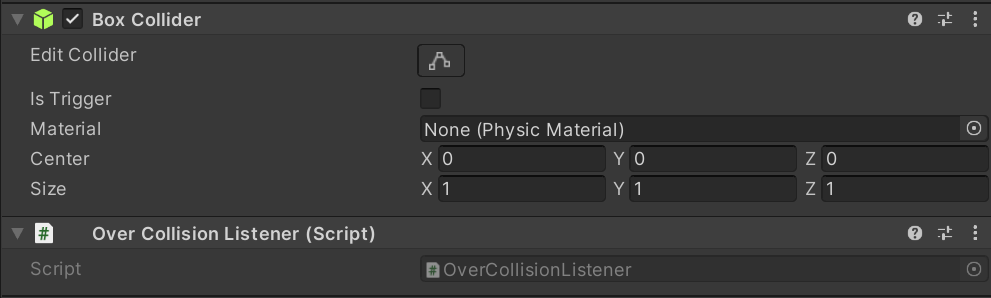
#### OverCollisionListener

In order for the Node system to communicate with the Unity Runtime environment, a OverCollisionListener component must be associated with the Target GameObject.&#x20;

Its main function is to provide a bridge between the node system and the UnityEngine event system, which handles collision events automatically.

<figure><img src="/files/awBIQilj2dJkGRhrnAYd" alt=""><figcaption></figcaption></figure>

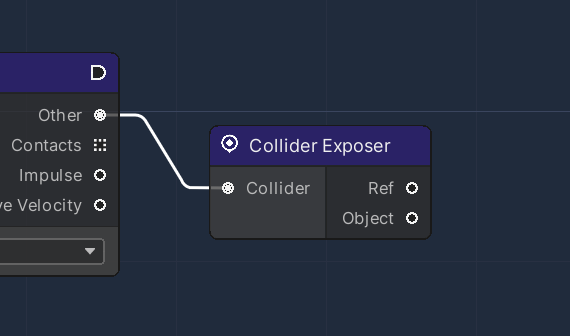
#### Collider Exposer

This node is used to expose certain parameters and attributes of a given input Unity [Collider](https://docs.unity3d.com/ScriptReference/Collider.html) Component, which are:

<table><thead><tr><th>Name</th><th width="204.3279424240331">Type</th><th width="340.1572968009442">Description</th></tr></thead><tbody><tr><td>Ref</td><td><a href="https://docs.unity3d.com/ScriptReference/Collider.html">Collider</a></td><td>A reference of the input Unity Collider Component</td></tr><tr><td>Object</td><td><a href="https://docs.unity3d.com/ScriptReference/GameObject.html">GameObject</a></td><td>GameObject associated to the collider</td></tr></tbody></table>

<figure><img src="/files/3E0wVYqqtrWKKAusir1c" alt=""><figcaption></figcaption></figure>


---

# Agent Instructions
This documentation is published with GitBook. GitBook is the documentation platform designed so that both humans and AI agents can read, navigate, and reason over technical content effectively. Learn more at gitbook.com.

## Querying This Documentation
If you need additional information that is not directly available in this page, you can query the documentation dynamically by asking a question.

Perform an HTTP GET request on the current page URL with the `ask` query parameter, and the optional `goal` query parameter:

```
GET https://docs.overthereality.ai/over-sdk-manual/over-visual-scripting-legacy/nodes/flow/other-events/collision.md?ask=<question>&goal=<endgoal>
```

`ask` is the immediate question: it should be specific, self-contained, and written in natural language.
`goal` is optional and describes the broader end goal you are ultimately trying to accomplish on behalf of the user. GitBook uses it to tailor the answer towards what is most useful for that goal.

The response will contain a direct answer to the question and relevant excerpts and sources from the documentation.

Use this mechanism when the answer is not explicitly present in the current page, you need clarification or additional context, or you want to retrieve related documentation sections.